Ketogenic Nutrition Outperforms Mediterranean and Low-Fat Plant Diets
New clinical research shows that what you eat matters—not just how much weight you lose.
Last week I interviewed Max Petersen from Washington University about his compelling new research that put ketogenic nutrition head to head with mediterranean and low-fat plant diets. For decades, we’ve been told by experts that weight loss is the key to improving metabolic health. Eat fewer calories, move more, lose weight, and your blood sugar, insulin resistance, and cardiovascular risk factors should improve. But even if you can lose that weight, does it matter what you eat to lose that weight?
A new randomized clinical trial published in Cell Metabolism provides compelling evidence that it does. Researchers at Washington University School of Medicine compared three popular nutritional approaches:
A very-low-carbohydrate ketogenic diet
A Mediterranean diet
A very-low-fat, plant-forward diet
The researchers carefully controlled the participants’ weight loss, ensuring that each group lost approximately 10% of its starting body weight. The remarkable finding? Despite nearly identical weight loss, the ketogenic group experienced substantially greater improvements in several important measures of metabolic health.
Three Diets, Similar Weight Loss, Different Results
The study included 42 adults with obesity, prediabetes, and metabolic dysfunction-associated steatotic liver disease (MASLD), commonly called fatty liver disease. Participants followed their assigned diets for approximately four to five months. All meals were provided by the research team, and participants received regular dietary counseling. The researchers weren’t simply comparing a group that lost considerable weight with another group that didn’t. They were comparing the metabolic effects of three very different diets after controlling so that there would be nearly identical weight loss.
1. Prediabetes Reversal: Ketogenic Wins
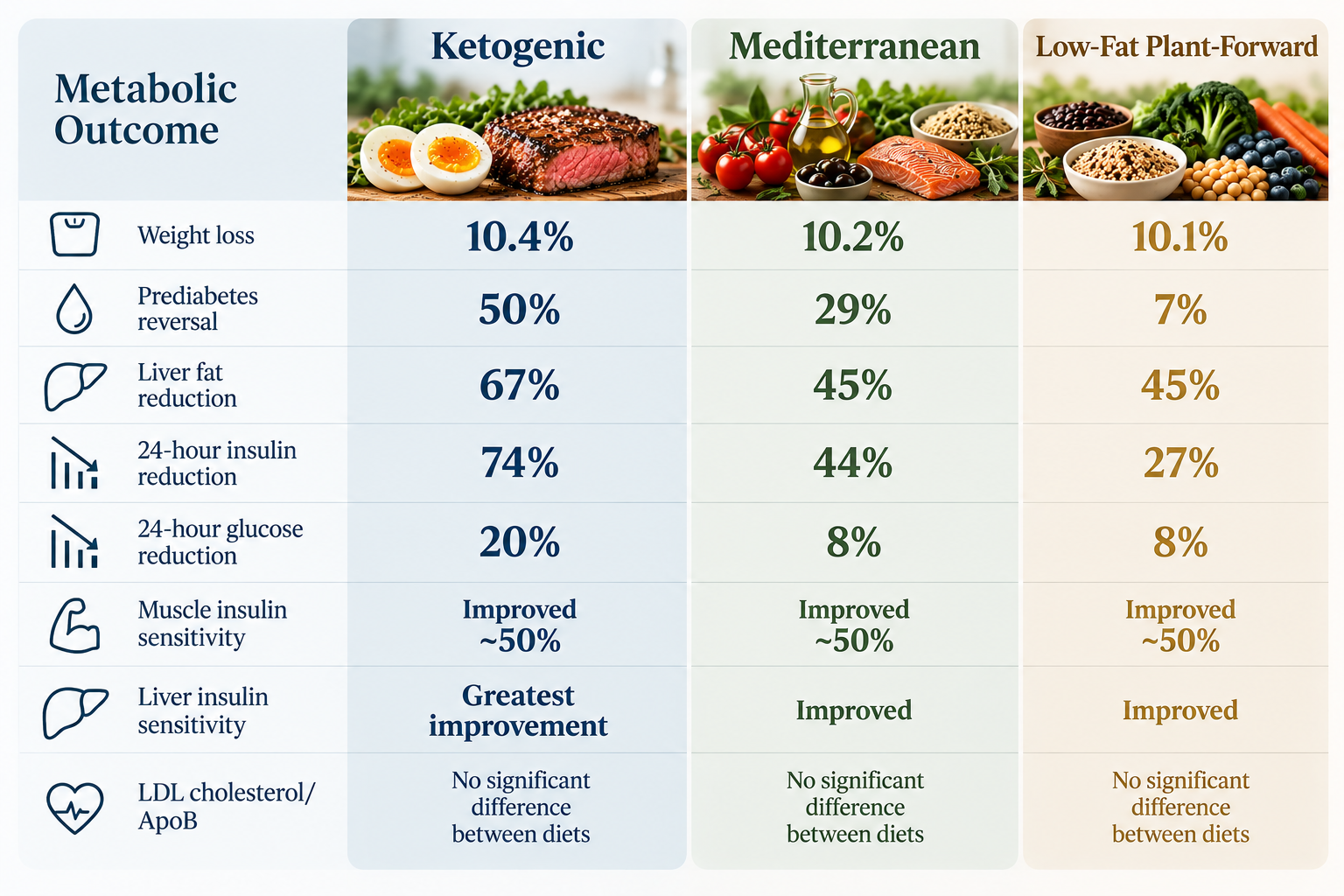
Perhaps the most clinically meaningful finding was the difference in prediabetes reversal. Half of the participants following ketogenic nutrition achieved reversal of their prediabetes, compared with fewer than one-third following the Mediterranean diet and only 7% following the low-fat, plant-forward diet. These findings are particularly relevant because prediabetes represents an early stage of metabolic dysfunction that frequently progresses to type 2 diabetes and in which glycation is already damaging the body. For patients struggling with insulin resistance and rising blood sugar, carbohydrate restriction provides greater benefits beyond simple weight loss.
2. Fatty Liver Disease: A 67% Reduction in Liver Fat
Metabolic Dysfunction-Associated Steatohepatitis (MASH or fatty liver) is closely associated with insulin resistance, obesity, and type 2 diabetes. Excess fat accumulation in the liver interferes with normal metabolic function and contributes to abnormal glucose regulation, as well as cardiovascular and kidney disease. All three diets substantially reduced liver fat by weight loss.
However, the ketogenic diet produced a significantly greater reduction. Liver fat decreased by approximately two-thirds in the ketogenic group, compared with less than one-half in the other two groups. This finding is especially important because fatty liver disease is increasingly recognized as a central feature of metabolic dysfunction.
The researchers also found that ketogenic nutrition produced the greatest improvement in hepatic insulin sensitivity (the liver’s responsiveness to insulin.) In fact, improvements in hepatic insulin sensitivity were approximately two to three times greater in the ketogenic group than in either comparison group. Limiting dietary carbohydrates has a particularly powerful effect on restoring normal liver metabolism.
3. Insulin Levels: A Dramatic Difference
Insulin is an essential hormone that helps regulate blood glucose, turn off fat oxidation, and promote tissue growth. It is the hormone of energy storage. Chronically elevated insulin levels are commonly associated with insulin resistance and numerous diseases. One of the most striking findings involved the participants’ insulin concentrations measured throughout a 24-hour period. The ketogenic group experienced a remarkable 74% reduction in circulating insulin exposure. The Mediterranean diet also produced a substantial improvement, while the low-fat diet produced a more modest reduction.
4. Blood Glucose: Ketogenic Nutrition Produces Greater Improvement
The researchers also measured participants’ blood glucose concentrations throughout the day. Unsurprisingly, the ketogenic diet produced approximately 2.5 times the reduction in daily glucose exposure compared with either alternative. Glucose regulation is not simply about a single fasting blood sugar measurement, it is about limiting glucose spikes that cause glycation, inflammation, and insulin production. For diabetes and prediabetes reversal, no diet comes close to a ketogenic approach.
5. Cholesterol and Triglycerides: An Important Finding
One of the most commonly repeated about ketogenic nutrition is its relatively high saturated fat content. In this particular study, the ketogenic diet provided 73% of calories from fat, including approximately 23% of total calories from saturated fat. Conventional nutritional recommendations suggest that this level of fat consumption would negatively affect cholesterol and cardiovascular risk markers.
However, consuming substantially more fat, participants following the ketogenic diet did not experience worse LDL cholesterol or apolipoprotein B outcomes than participants following the Mediterranean or low-fat diets.
The three groups showed no statistically significant differences in changes in:
LDL cholesterol
Apolipoprotein B (ApoB)
Total cholesterol
Average 24-hour triglyceride concentrations
Fasting triglycerides improved in all three groups, with the greatest reduction occurring in the ketogenic group. HDL cholesterol tended to increase in the ketogenic group while decreasing in the Mediterranean and low-fat groups. These results strongly challenge the assumption that consuming more dietary fat necessarily produces worse blood lipid outcomes.
6. What About Muscle Insulin Sensitivity?
Not every outcome favored ketogenic nutrition. All three groups experienced approximately a 50% improvement in skeletal muscle insulin sensitivity. There were no significant differences among the diets for this outcome.
This is an important reminder that weight loss itself provides substantial metabolic benefits Regardless of the dietary approach, losing excess body fat can improve the body’s ability to use glucose effectively. However, the ketogenic diet provided additional benefits in liver metabolism, glucose regulation, and insulin exposure that were not explained simply by losing more weight.
The Big Picture: Comparing the Three Diets
See original paper here: https://www.cell.com/action/showPdf?pii=S1550-4131%2826%2900293-7
What Does This Mean for Patients?
At Re:Generations, we emphasize that nutrition is much more than a strategy for controlling calories. Food choices affect our hormones, hunger, metabolism, energy production, blood glucose, inflammation, and long-term health. For patients struggling with obesity, insulin resistance, prediabetes, type 2 diabetes, or fatty liver disease, we frequently recommend a well-formulated ketogenic diet as a therapeutic nutritional intervention.
This doesn’t mean that everyone needs to follow a ketogenic diet indefinitely. Nor does it mean that Mediterranean or plant-forward diets are unhealthy. Both produced meaningful improvements in this study. But notice that all three diets differed widely from the traditional American diet, full of highly processed foods, sugar, and other simple carbohydrates. That change, a move toward the things God made for food, is rule number one of healthy eating. But beyond moving away from processed foods, different nutritional approaches can produce substantially different metabolic results, even when weight loss is identical.
My Takeaway: Weight Loss Is Important, but Metabolic Health Is the Goal
For years, much of the conversation about obesity has centered on calories and body weight. But the scale tells only part of the story. Two individuals can lose the same amount of weight while experiencing very different changes in blood glucose, insulin resistance, cardiovascular and kidney health, and liver health. This study demonstrates that principle particularly well. The goal shouldn’t simply be to weigh less. The goal should be to become metabolically healthier.
Citation: Petersen MC, et al. Effect of diet macronutrient content on the cardiometabolic response to weight loss: A randomized clinical trial. Cell Metabolism. 2026. DOI: 10.1016/j.cmet.2026.07.020